Rich’s Take: Spoiled Milk by Avery Curran
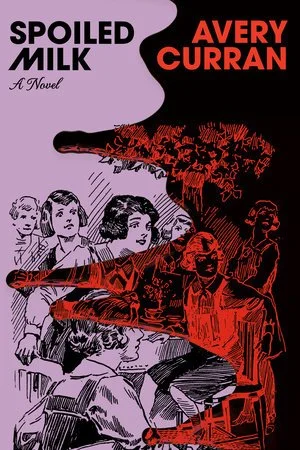
We’re big on vibes at Genre Buzzword - it's a key component of our mission statement and rating system after all - so it should come as no surprise to our readers that I’m obsessed with Historical and Gothic Horror. I think these subgenres are unmatched in terms of establishing an atmosphere that not only permeates the entire novel, but almost becomes a character and enhances the reading experience. Just the term “Gothic Horror” elicits images of windswept moors, crumbling manor homes, and other isolated locales where unease and paranoia slowly envelopes characters and readers alike. So the fact that I got to read Spoiled Milk by Avery Curran in the area where the Spiritualism movement was born as the damp cold and gray skies of winter kept spring at bay only enhanced the experience.
Spoiled Milk takes place in 1928 as Emily Locke and her friends prepare for their final year of school at the Briarley School for Girls, which fits the profile of the dusty, cobweb-laden atmosphere of the genre perfectly. What’s supposed to be a time of happy memories and the culmination of years of friendship is marred when Emily Locke discovers her best friend Violet’s body after a fatal fall. She’s convinced that Violet’s death wasn’t an accident and she immediately suspects the French schoolmistress Violet was spending so much time with, Mademoiselle LeFevre. Violet was the “It” girl at school and someone all of the girls admired and wanted to impress, especially Emily. Emily viewed their relationship as special and her rivalry with classmate Evelyn seems to stem from her insecurity around Evelyn’s gestures towards Violet. Which makes it even more surprising when Evelyn is one of the few people that agrees with Emily’s theory that Violet was murdered. As the food at Briarley begins to rot and more of their schoolmates die, the girls realize something is poisoning the halls of Briarley and it wants them to suffer. Desperate for answers, the girls turn towards Spiritualism and find out that not only is everything they thought they knew wrong, something dangerous is coming for them all.
One of the things that Curran does the best is handle the large cast of characters that make up Emily’s friend group and capture the complex relationship dynamics at play. Every girl at Briarley has their own personality trait - Dot is one that needs the most protection and reassurance, Evelyn is the self-righteous one, Alice is the brave one and the fighter. By creating archetypes for all of the girls, it not only helps the reader keep track of them, but serves as the foundation of their personalities. Though - as Curran proves multiple times throughout the novel - there are hidden strengths within each of the girls and they often defy reader expectations. Whether that be Marion rising up to serve as the next de facto leader or the straight-laced Evelyn serving as a crucial figure in the girl's experiments communicating beyond the veil.
They may fight a lot when faced with the pressures of the mounting paranoia and dangers of whatever is targeting them, but the impressive thing is the girls always stick together. Their bond is incredibly strong and that may be one of the reasons whatever is haunting the grounds of the school tries to fracture their friend group; so it can pick them off one by one. But countless times they rally around each other and Emily even says they’re the closest thing to a real family she’s ever had. It’s that closeness that allows Curran to deeply explore queer desire with such nuance because the girls know each other almost as well as they know themselves. A good example is the relationship between Alice and Dot, which isn’t directly characterized as romantic at first, but their interactions and tenderness towards one another makes it obvious. It’s through these scenes - along with Alice’s gentle presence of support - that Evelyn is able to wrestle with her own feelings and possible internalized homophobia.
I loved the portrayal of mediums and Spiritualism movement that comes through beautifully through Curran's background on the subject. I especially loved the portrayal of Mrs. Northcote. It would’ve been easy to paint her as an eccentric crone or huckster and play up on the stereotypes people associate with mediums from that time period, so I applaud Curran for making her seem like an ordinary grandmother or aunt and painting her in a way that makes her seem trustworthy. It’s also through Mrs. Northcote that readers learn of some of the horrible ways that mediums were treated in the past when religion has a much more prominent role in society and people were less open to the idea of spirits and communicating with them. I also love the inclusion of more traditional elements around hauntings and Spirtualism. The eeriness of the seance scenes - particularly the first one at Mrs. Northcote’s - were masterfully done and invoke a sense of dread without over the top theatrics. Also, this is the first book in a long time that utilizes ectoplasm when it comes to hauntings and seances. Who doesn’t love a heaping helping of ectoplasm?!
While Spoiled Milk honors the traditions of Gothic Horror, Curran also introduces fresh themes by exploring queerness during the age of Spiritualism and also creating one of the most pulse-pounding scenes I think I’ve ever read in a genre that’s more known for atmosphere and subtle chills. There was just a little too much ambiguity for my tastes when it came to what was plaguing Briarley and why it was occurring at that time, but overall I had a blast with Spoiled Milk and the fantastic character development more than made up for it. I hope this is just the first of many, many forays into Gothic Horror for Avery Curran because she’s crafted a stellar entry into the tradition and I feel like she could push it in some bold, new directions.
Vibes: 4/5