Rich’s Take: Phantom Constellations by Daniel Braum
I’ve gone on record numerous times over the years about my love for big, doorstop type books. For a majority of my reading life, I gravitated towards them because I love the feeling of losing myself in richly developed worlds populated with a diverse cast of characters. In the hands of the right writer, this length is like magic. They’re portals into other worlds where anything’s possible; where the writer has the time and the space to let every aspect of the story breathe and unfurl at its own pace. Personally, it’s the journey the author takes me on that I derive the most joy from more so than the destination. However, after embarking on my personal journey into the world of book reviewing and writing fiction, there’s been a gradual shift in my tastes toward short stories. Don’t get me wrong, I still love novels, but as a reader, I’ve started to appreciate the craft that goes into effective short fiction and the elegance of the structure. As a writer, I’m drawn to the challenge of working within the constraints of the format and being economical with my choices. Reading works from writers like Damien Angelica Walters, John Langan, Mariana Enriquez and so many others taught me that not only are those same magical qualities possible in short stories, sometimes they’re much more effective.
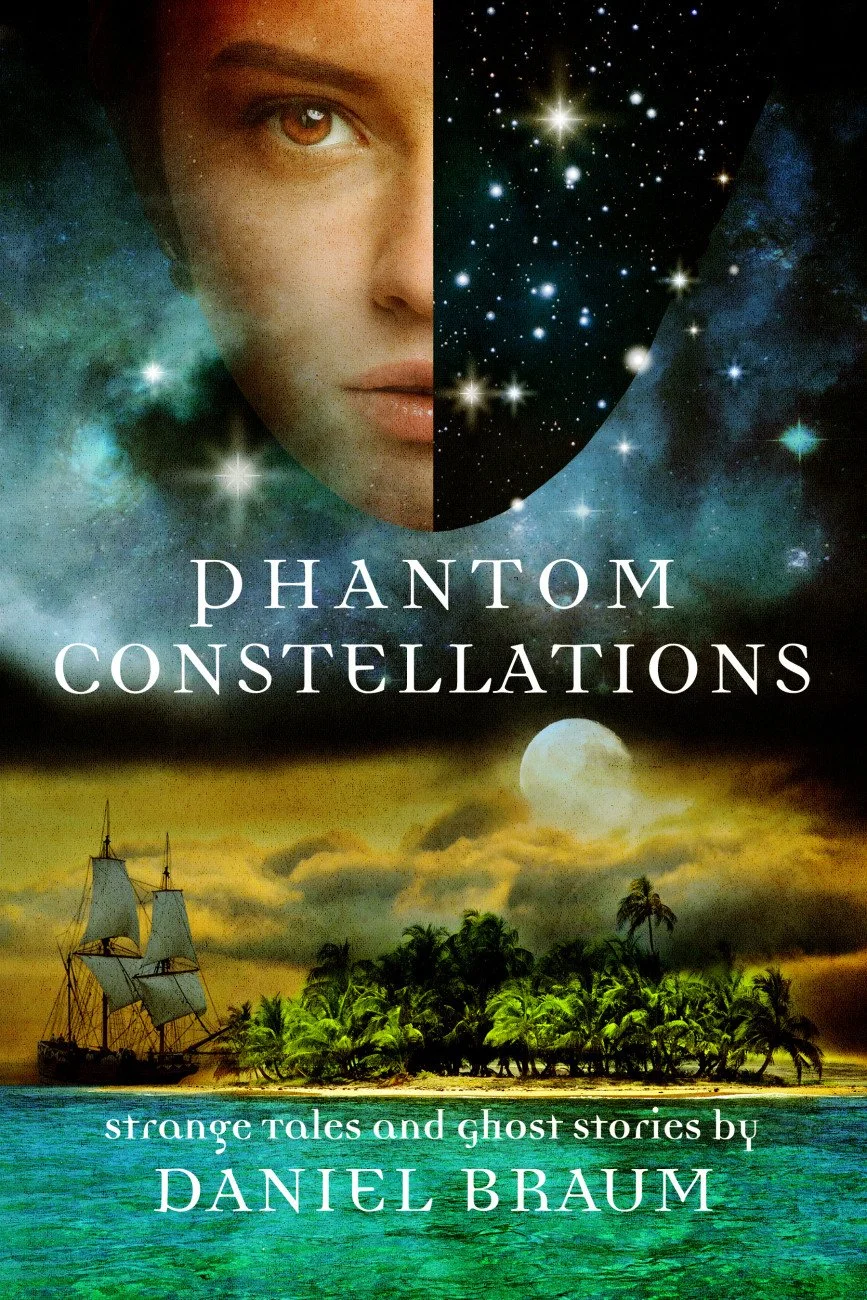
That’s very much the case in Daniel Braum’s latest collection, Phantom Constellations, which features new and previously published stories. Braum establishes the vibes and theme of this collection in his introduction by saying that our lives, our loves, and our relationships with the world around us are nothing more than phantom constellations, only given shape by the meaning we assign them through our own worldview. That theme is heavily prevalent throughout Phantom Constellations and the genre-defying stories that thrive in the liminal spaces that border our reality and the realms of the unknown. These stories also made me realize something. Often when people discuss art that deals with liminality, the focus always seems to be on spaces, whether it be physical or metaphysical. But considering the nature of the word and the concept, why’s that always the default? Braum’s stories have a heavy focus on the concept and while he does explore it in terms of physical spaces, he pushes beyond that and applies that lens to emotions, relationships, and even story structure.
The first story in the collection, “Scarecrow and the Imposter”, is a great exploration of liminality from multiple angles. The story focuses on Nate Arcane, a man who dabbles in the occult, and who has dedicated most of his life trying to catch an entity known only as Scarecrow. Despite Nate’s knowledge of magic and demon hunting, Scarecrow is able to constantly evade his traps because it’s able to hop bodies whenever it senses it’s in danger. Considering Nate blames this entity for the tragedy that’s become his life, he’s unable to give up on his mission and must reluctantly rely on the help of his rival Ava. What follows is not only a final confrontation with the entity known as Scarecrow, but a confrontation with the mistakes he’s made and the paths his life could’ve taken. It’s a haunting story that examines elements of love, regret, and the choices that define us set against a backdrop of lush forests and small towns in the Catskills.
“Twenty-Nine Palms in Reverse” is a story about Yuli and Noam, who travel to Twenty-Nine Palms to explore the desert and for Yuli to show Noam a different side of herself, to maybe let him see her for who she really is and form a stronger bond. At 35, Yuli is feeling restless and wants a future with Noam, but she has her doubts. Unbeknownst to Noam, Yuli has brought him here for her to decide if she wants to forge ahead in a life together or leave him. This is another excellent example of liminality and Braum’s theory of phantom constellations. Yuli and Noam are in a relationship together, but they have different views and meanings of what that relationship means. Noam seems steadfast in his feelings and is pushing for Yuli to let go of her past and for them to forge new memories together while Yuli clings to memories, stuck in between two phases of her life and plagued by visions of a woman only she can see in the distance of the desert. There’s a beautiful line in this story that really resonated with me: “Maybe the reason being a couple isn’t to know everything about each other. Maybe it is what will be seen together. The uncharted ground, like he said yesterday.” Because what is a relationship if not the ultimate liminal space?
Stylistically, I love that Braum included interconnected stories. “A Loch Ness Monster Under the Light of the Southern Cross” and “Tiki Bar at the Edge of Forever” both center around the same traumatic event, but it’s explored through the experiences of different characters and told in a non-linear timeline. I’m a huge fan of stories that upend traditional story structure and Braum does so beautifully with these two stories while remaining true to the theme of the collection. He also uses structure to explore liminality, as many of the stories end in ways that encourage further reflection from the reader. There are stories that end with a character’s life hanging in the balance and others that end at the moment a character is presented with a crossroads. While this may be frustrating to some readers who prefer a neat, clean ending, I loved Braum’s choices. You might remember at the beginning of this review that I mentioned I love the journey of a story more so than the destination and that certainly is a part of it. However, I also liked these choices because they mirror the messy reality of life. Not every story or event in our lives has a clearly defined beginning, middle, and end. Some exist purely in a liminal state.
Braum states that good fiction is made from human choices and that is where both this collection - and Braum’s writing in general - soar. Every story is full of complex characters who make good and bad choices and wrestle with their flaws, grief, and regrets in a way that feels both authentic and relatable. Phantom Constellations is full of elegant prose and a heaping dose of melancholy and further proves why Braum is one of my favorite short story writers. If you’re looking for beautifully written fiction that isn’t afraid to blend the unknown with the ordinary and that pushes you to reflect, this collection is not to be missed.
Vibes: 5/5